Is the Cloud Really Cheaper? A Data-Driven Cost Comparison
2026-02-25
Is the Cloud Really Cheaper? A Data-Driven Cost Comparison
“Cloud is cheaper.”
It’s one of the most repeated statements in modern tech.
But is it actually true?
The honest answer: it depends on what you’re running, how you’re running it, and how long you plan to run it.
Let’s break it down with logic, numbers, and real-world context.
Step 1: What Are We Comparing?
There are two fundamentally different cost models.
🏢 On-Premises Infrastructure
You buy and manage: Physical servers Storage systems Networking equipment Power and cooling IT staff
You own the hardware. You handle failures. You replace equipment every few years.
☁️ Cloud Infrastructure
You rent computing resources from providers like:
Amazon Web Services Microsoft Azure Google Cloud Platform
No physical hardware. No large upfront investment. You pay monthly, based on usage.
Different ownership. Different financial behavior.
Step 2: The Cost Breakdown (With Numbers)
Let’s take a realistic example.
Scenario:
A growing web application needs: 3 application servers 1 database server 2 TB storage Moderate traffic
Option A: On-Prem Costs (3-Year Estimate)
Upfront costs:
Servers: ~$40,000 Networking & setup: ~$15,000 Backup & redundancy: ~$10,000 Installation & configuration: ~$10,000
Initial total: ~$75,000
Operational costs (3 years) Power & cooling: ~$12,000 Maintenance contracts: ~$18,000
Total over 3 years: 👉 ~$100,000+
And that’s before scaling.
Option B: Cloud Costs (3-Year Estimate)
Estimated monthly usage: Compute: ~$500 Storage: ~$60 Data transfer: ~$100
Monthly total: ~$660
3-year total: 👉 ~$23,760
Even if we double that for growth and overhead: 👉 ~$45,000
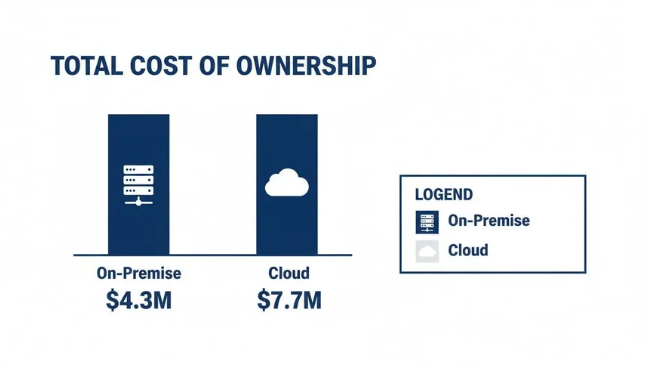
In this case, cloud is significantly cheaper. But that doesn’t mean it always is.
When the Cloud Is Clearly Cheaper
1️⃣ Startups & Early-Stage Companies
Startups usually don’t have $100K to invest in infrastructure.
Cloud allows them to: Launch quickly Start small Scale gradually Avoid upfront capital risk
Speed matters more than hardware ownership at this stage.
2️⃣ Unpredictable Traffic
If usage fluctuates: Seasonal spikes Marketing campaigns Viral growth
Cloud automatically scales.
With on-prem, you either: Overbuy hardware (wasted money), or Underestimate and crash.
3️⃣ Experimentation & Innovation
Cloud lets you: Spin up servers in minutes Test new features Shut things down instantly
That flexibility reduces risk and encourages innovation. And innovation often drives revenue.
When On-Prem Can Be Cheaper
1️⃣ Stable, High-Utilization Workloads
If your systems: Run 24/7 Operate at 80–90% utilization Remain predictable for years
Owning hardware may become cheaper long term.
This is why some large-scale companies rethink cloud-heavy strategies.
For example, Dropbox moved significant workloads to custom infrastructure once they reached massive scale to reduce long-term costs.
At that level, small efficiency improvements mean millions saved.
2️⃣ Heavy Data Transfer
Cloud providers often charge for outbound data. If your business: Streams video Transfers large datasets Serves global high-volume traffic
Data egress fees can quietly increase your bill.
3️⃣ Poor Cost Management
Cloud is easy to start. It’s also easy to overspend. Common issues: Idle instances Oversized virtual machines Forgotten storage Lack of monitoring
Without discipline, monthly bills grow fast.
The Financial Psychology: CapEx vs OpEx
On-prem requires CapEx (capital expenditure). Big upfront payment. Asset ownership.
Cloud shifts to OpEx (operational expenditure). Smaller recurring payments.
Cloud feels cheaper because: You don’t pay everything at once. Monthly bills seem manageable.
But over 5–7 years, subscription-style infrastructure can accumulate significantly.
Cloud doesn’t eliminate cost. It changes the timing and structure of cost.
So… Is the Cloud Really Cheaper?
✅ Yes, if: You’re a startup or scaling company Workloads are unpredictable Speed and flexibility are priorities You want low upfront risk
❌ Not always, if: Workloads are stable and heavy Utilization stays consistently high You operate at massive scale
The Modern Strategy: Hybrid Thinking
Today, many organizations don’t choose one extreme.
They combine: Stable core systems on owned infrastructure. Dynamic, scalable workloads in the cloud.
It’s not about trends. It’s about financial alignment with business goals.