
The Future of Programming: Will Developers Still Code in 10 Years?
2026-03-03
The Future of Programming: Will Developers Still Code in 10 Years?
-Aneshya Das
Everyone has seen the panic on their feeds by now. "An AI just built a functional website in 10 seconds. Software engineering is dead." It is the tech world's new favorite doomsday prophecy.
If you just look at the surface, it’s easy to believe. You ask a chatbot for a standard React component or a basic data fetching function, and it spits it out flawlessly before you’ve even taken a sip of your coffee. If that is what you think "coding" is, then yes, the future looks pretty bleak for human developers.
But let’s take a collective breath and look at what is actually happening. We aren't witnessing the death of programming; we are watching the death of the "syntax typist."
Let me break down why the developer of 2036 will still be very much employed, just doing a completely different job.
Layer 1: The New Compiler Think about the history of computer science. Decades ago, developers wrote in Assembly language—literally moving bits around in memory. Then came C, then Python, then high-level frameworks. Every time we added an abstraction layer, people panicked that "real coding" was dying.
AI is just the newest abstraction layer. It is the new compiler. We are moving away from writing boilerplate code and moving towards "orchestration." Instead of spending an hour setting up standard routing, we will delegate that to an AI agent. But the fundamental logic? That is still on us.
Layer 2: System Design Over Syntax This is where the reality check hits the AI hype. An AI is fantastic at writing isolated, single-file functions. But software is rarely an isolated function.
Ask an AI to generate a login form, and it wins. But ask an AI to securely connect a React frontend to an Express.js backend, route it through a MongoDB database, handle authentication tokens securely, and manage complex state across a massive user base without crashing? Suddenly, your "AI developer" gets confused, hallucinates, and breaks the build.
The same applies to machine learning. An AI can spit out the boilerplate Python script to build a neural network. But when your Convolutional Neural Network (CNN) starts wildly misclassifying data, or your NLP model struggles with complex, code-mixed data like Hinglish because of weird tokenization issues, AI cannot intuitively troubleshoot the data constraints.
Putting the puzzle pieces together, understanding edge cases, and ensuring security requires an overarching architectural vision. AI is the bricklayer; the developer is the architect.
Layer 3: The Debugging Nightmare If you think debugging your own code is painful, wait until you have to debug millions of lines of code generated by a black-box AI model that hallucinates 5% of the time.
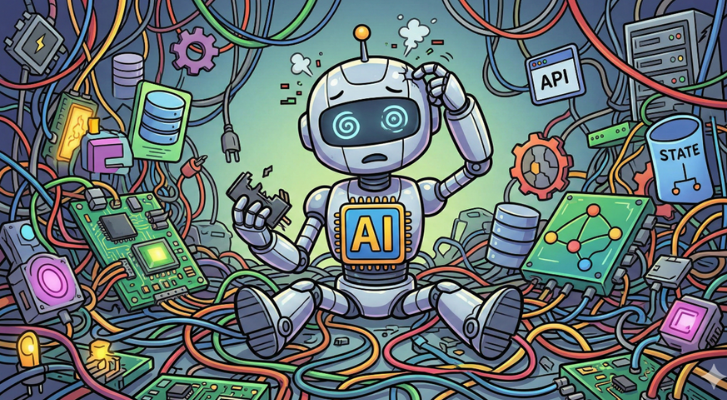
Image Source: gemini.google.com
As AI generates more code, the value of a developer who can actually read, trace, and fix complex system architectures will skyrocket. The future belongs to problem solvers, not code monkeys.
The Verdict Will we still "code" in 10 years? If by coding, you mean manually typing out every single bracket and semicolon, then probably not.
But if you mean breaking down complex human problems into logical, scalable, and secure technical systems? Absolutely. In fact, it's going to be more important than ever.
In the end, AI won't replace developers. But a developer who knows how to orchestrate AI will absolutely replace a developer who doesn't. So, keep building, keep debugging, and maybe just let the AI write your CSS.